



What Is a Charter School?
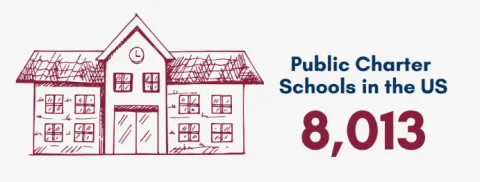
A charter school is a public school of choice that operates under a performance contract, or "charter," with an authorized public chartering agency. In exchange for meeting specific academic and operational goals, charter schools have greater flexibility in how they operate compared to traditional public schools.
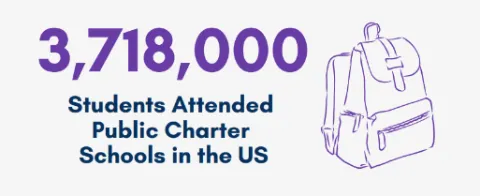
Charter schools are tuition-free, open to all students, and cannot be affiliated with a religious institution. They are held to high standards of academic performance, financial responsibility, and transparency. Families choose to enroll their children, and schools must deliver results to remain open.
This combination of autonomy and accountability allows charter schools to innovate while ensuring students have access to a high-quality education. For further details, see our Key Charter Terms and Definitions.
Charter School Facts at a Glance
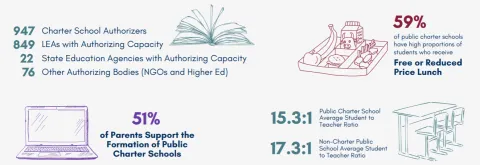
Charter schools play a growing role in education across the country. The data below highlight key insights about authorizers, student demographics, parental support, and classroom conditions in charter schools compared to traditional public schools.

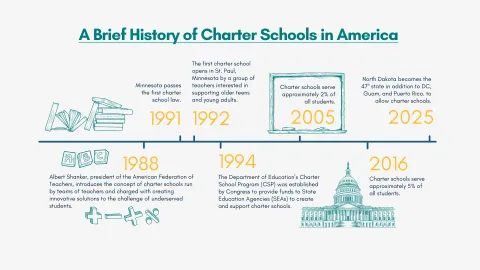
A History of Charter Schools in America
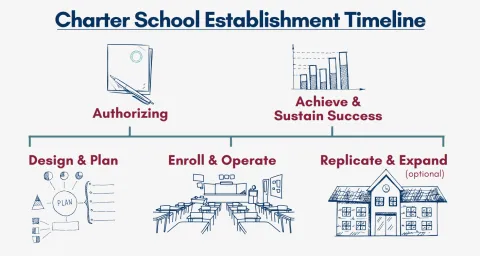
Life Cycle of a Charter School
To find more information about charter schools, visit our FAQ page.
Step 1: Design and Planning
An individual, group, or CMO identifies a need for a new school. They confirm that charter schools are allowed in their state and that capacity limits allow for a new school. The applicant drafts a mission, sets up governance, creates a budget, identifies funding, selects a location, and prepares a charter application.
Step 2: Authorizing
The applicant submits a letter of intent and application to an authorizer. Authorizers decide who can open a school, set performance expectations, and oversee results. Authorizers may include state agencies, school districts, universities, or nonprofit organizations. The type and number of authorizers vary by state.
Step 3: Preparing to Open
After approval, the operator prepares for the launch. This includes hiring staff, developing curriculum, setting policies, securing a facility, and purchasing supplies. Many charters start without traditional school buildings or district-provided resources, so operators must plan for all operational needs independently.
Step 4: Enrollment and Operations
Charters enroll students through an open, non-discriminatory process. If applications exceed capacity, they must hold a random lottery. Once enrollment is complete, the school begins offering instruction and services.
Step 5: Achieving and Sustaining Success
Charters are reviewed regularly, often every five years, to assess academic, financial, and operational performance. Strong performance is essential to maintain the charter and build trust with families and authorizers.
(Optional) Replication and Expansion
High-performing schools may expand or replicate. CSP grants support growth through additional seats, new grade levels, or new schools. Some charters choose to stay small and focused on a single community or mission.